
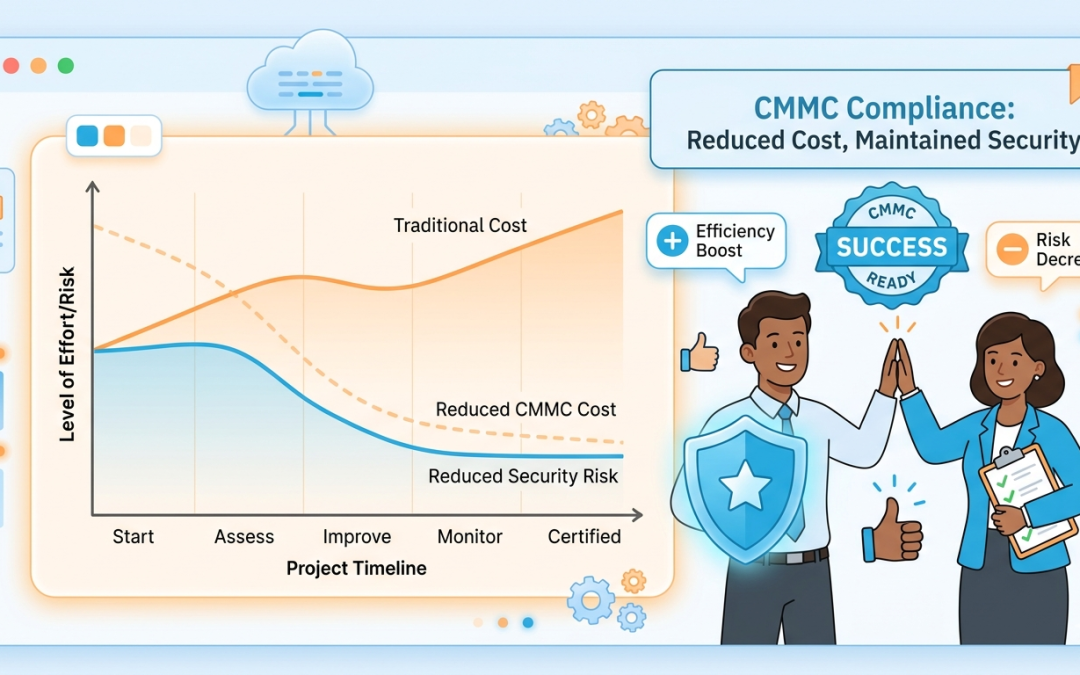
For many manufacturers and defense contractors, one concern comes up immediately when discussing compliance: CMMC cost.
You have likely heard stories about companies spending tens or even hundreds of thousands of dollars trying to meet requirements. Some overspend on tools they do not need. Others take shortcuts and end up failing their CMMC assessment, which creates even more cost later.
The reality sits somewhere in the middle. You can reduce your CMMC cost without cutting corners, but only if you focus on the right areas from the start.
This guide breaks down practical, real-world ways to control cost while still meeting CMMC compliance and protecting your business.
Why CMMC Cost Gets Out of Control
Most companies do not overspend on purpose. Costs usually rise because of confusion, poor planning, or buying the wrong solutions too early.
A common mistake is jumping straight into tools. Companies hear about security platforms, monitoring systems, and software subscriptions, and assume they need all of them right away. Without a clear plan, spending increases quickly.
Another issue is misunderstanding your required level. CMMC Level 1 applies to organizations handling Federal Contract Information, while CMMC Level 2 requirements apply to companies handling Controlled Unclassified Information. If you prepare for the wrong level, you can easily overbuild your environment.
There is also the cost of rework. If your CMMC documentation does not match your actual environment, or if controls are only partially implemented, you may fail your first CMMC assessment and have to fix issues later. That is one of the most expensive paths.
The key to managing CMMC cost is getting aligned early and building correctly the first time.
Start With Scope Before Spending
One of the most effective ways to reduce CMMC cost is to clearly define what actually falls under compliance.
Not every system, device, or employee needs to be included. The goal is to identify where sensitive data lives, especially CUI, and limit the compliance boundary to only what is necessary.
This is often called scoping.
If your organization spreads CUI across multiple systems, networks, or locations, your compliance effort becomes larger and more expensive. On the other hand, if you contain that data within a smaller, controlled environment, you reduce both complexity and cost.
This approach aligns with NIST 800-171, which focuses on protecting systems that store or process sensitive information. By reducing the number of systems in scope, you reduce the number of controls you need to implement.
For manufacturers, this might mean separating engineering systems from general office systems or using a dedicated environment for handling controlled data.
Done correctly, scoping is one of the biggest drivers of lower CMMC cost.
Do Not Overbuild Your Security Stack

Another major cost driver is overengineering your security environment.
Many companies assume they need enterprise-level cybersecurity tools across their entire organization. In reality, CMMC compliance is about meeting specific control requirements, not buying the most expensive tools available.
For example, NIST 800-171 requires access control, logging, incident response, and system protection. There are often multiple ways to meet these requirements.
Some companies achieve compliance using well-configured commercial tools like Microsoft 365, while others invest in complex custom solutions. Both can work, but one is usually far more cost-effective.
The key is to choose tools that meet requirements without adding unnecessary complexity.
Overbuilt systems not only increase upfront cost but also raise long-term expenses related to maintenance, training, and support.
Build Strong CMMC Documentation Early
It might not seem obvious, but strong CMMC documentation is one of the easiest ways to reduce cost.
Clear policies and procedures help your team understand how to handle data, follow security practices, and maintain consistency. Without them, employees make decisions on their own, which leads to mistakes.
From an assessment standpoint, documentation is critical. During a CMMC assessment, assessors look for alignment between your policies, your procedures, and your actual environment.
If your documentation is incomplete or inaccurate, you may need to spend time fixing gaps before passing your assessment.
Good documentation reduces confusion, speeds up implementation, and prevents costly rework. It also helps your organization maintain compliance over time instead of constantly reacting to issues.
Prepare for Your CMMC Assessment the Right Way
Trying to rush into a CMMC assessment is one of the fastest ways to increase cost.
Companies that are not fully prepared often fail on their first attempt. This leads to remediation efforts, additional consulting fees, and delays in contract eligibility.
A better approach is to conduct an internal readiness review before scheduling your assessment. This allows you to identify gaps, fix issues, and ensure your environment aligns with CMMC Level 1 or CMMC Level 2 requirements.
Think of this as a dry run. It is much less expensive to fix problems before an official assessment than after.
Preparation also includes training your team. Employees should understand how to handle CUI, follow security procedures, and respond to common scenarios. Human error is a major source of compliance gaps, and training helps reduce that risk.
Use a Phased Approach
Trying to tackle every requirement at the same time can quickly drive up CMMC cost.
A phased approach allows you to focus on high-impact areas first, then build out the rest over time.
-For example, you might start with:
-Identifying and securing systems that handle CUI
-Implementing access controls and user management
-Establishing basic policies and procedures
From there, you can expand into areas like monitoring, incident response, and advanced controls.
This approach spreads cost over time and reduces the risk of making rushed decisions.
It also helps your team adapt gradually instead of being overwhelmed by a full compliance overhaul.
Avoid the “Checkbox” Mentality
One of the biggest mistakes companies make is treating CMMC compliance as a checklist exercise.
They focus on checking off requirements without fully implementing them. This often leads to weak controls that do not hold up during an assessment.
For example, a company might create an incident response plan but never train employees on how to use it. On paper, the requirement is met. In reality, the control is not effective.
This approach increases risk and often leads to additional cost later when controls need to be fixed or improved.
True compliance means building processes that actually work. When controls are implemented properly the first time, you avoid rework and reduce long-term cost.
Leverage Existing Systems and Processes
Most organizations already have some level of security in place. The key is to build on what you have instead of starting from scratch.
For example, you may already have:
-User account management processes
-Backup systems
-Antivirus or endpoint protection
-Basic access controls
Instead of replacing everything, evaluate how these systems align with NIST 800-171 and CMMC requirements.
In many cases, small adjustments can bring existing tools into compliance. This is far more cost-effective than implementing entirely new systems.
Train Your Team to Reduce Risk and Cost
Technology alone will not ensure CMMC compliance. Your team plays a major role in protecting sensitive information.
Training employees on how to recognize and handle CUI, follow security procedures, and avoid common mistakes can significantly reduce risk.
It also reduces cost. Fewer mistakes mean fewer incidents, fewer compliance gaps, and less time spent fixing issues.
Training should be simple, practical, and relevant to your operations. For manufacturers, this might include how to handle technical drawings, share files securely, and follow access control procedures.
Plan for Ongoing Compliance, Not Just Certification
CMMC is not a one-time project. Maintaining compliance over time is just as important as achieving certification.
Companies that treat compliance as a one-time effort often face higher costs later when controls drift or documentation becomes outdated.
Building processes that support ongoing compliance helps avoid these issues.
This includes:
-Regular reviews of your CMMC documentation
-Periodic internal assessments
-Continuous improvement of security practices
By maintaining compliance consistently, you avoid large, unexpected costs in the future.
Reducing CMMC cost is not about cutting corners. It is about making smarter decisions.
When you clearly define your scope, avoid overbuilding, invest in strong documentation, and prepare properly for your CMMC assessment, you can control costs without increasing risk.
For manufacturers and defense contractors, the goal is to build a compliance program that works in the real world. One that protects sensitive information, meets CMMC requirements, and supports long-term success in the defense supply chain.
Done right, CMMC compliance becomes an investment in your business, not just an expense.
Need A CMMC CUI Kit?
Kickstart your compliance with our free Starter Pack CMMC CUI Kit. Get practical materials, labels, and signs to start handling CUI correctly and move toward CMMC compliance with confidence.