
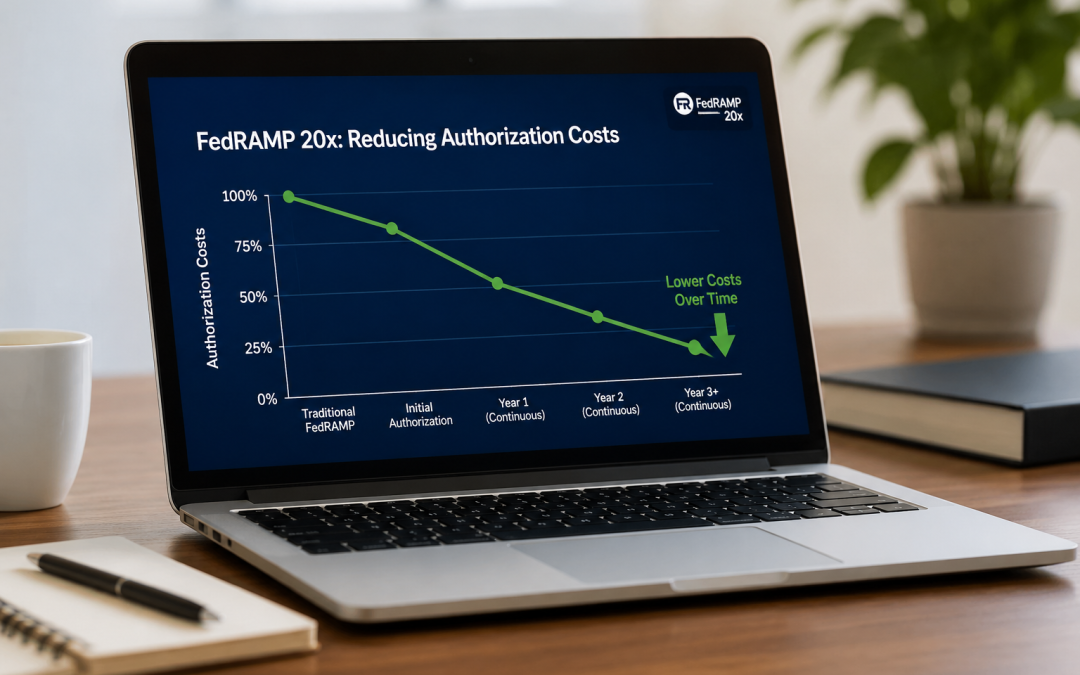
How FedRAMP 20x Can Reduce Cloud Certification Costs
FedRAMP 20x does not reduce costs by lowering federal security expectations. It may reduce unnecessary spending by improving scope, evidence reuse, automation, persistent validation, assessment readiness, and the accuracy of the certification package.
Executive Summary
Why Does FedRAMP Certification Cost So Much?
FedRAMP is not a single audit fee. It is a cloud security, engineering, documentation, assessment, and ongoing operating program.
A provider may need to redesign architecture, establish a federal service boundary, improve identity controls, centralize logging, remediate vulnerabilities, document security decisions, prepare evidence, support independent assessment, and maintain certification information after approval.
The provider must also account for internal labor. Engineering, DevOps, security, compliance, identity, product, legal, leadership, finance, and customer teams may all contribute time.
The most expensive projects are usually not caused by one large invoice. Costs grow because gaps are discovered late, work is repeated, scope is unclear, evidence is scattered, and formal assessment begins before the service is ready.
The later a major scope, architecture, evidence, or security problem is discovered, the more expensive it usually becomes to correct.
Service Boundary
More applications, regions, infrastructure, identities, integrations, support systems, pipelines, and external providers increase implementation and assessment work.
Engineering Remediation
Missing security capabilities involving identity, logging, encryption, configuration, vulnerability management, resilience, and secure development create major costs.
Certification Documentation
Providers need accurate security decisions, diagrams, inventories, responsibilities, evidence, metrics, assessment records, and supporting procedures.
Independent Assessment
Assessment cost depends on class, scope, service complexity, testing effort, evidence quality, findings, retesting, and assessor coordination.
Security and Compliance Tools
Providers may need scanning, identity, logging, configuration, ticketing, inventory, backup, monitoring, evidence, and reporting capabilities.
Ongoing Operations
Continuing costs include vulnerabilities, incidents, evidence maintenance, validation, changes, assessment support, reporting, and certification updates.
How FedRAMP 20x Changes the Cost Model
FedRAMP 20x moves the program toward maintained Security Decision Records, Key Security Indicators, machine-readable certification data, measurable outcomes, persistent validation, and class-based assurance requirements.
This can reduce cost when operational security systems generate evidence that can be reused throughout certification and maintenance.
Instead of repeatedly asking employees to capture screenshots, reconcile spreadsheets, update disconnected documents, and respond to the same evidence requests, providers may build repeatable evidence processes.
The savings depend on maturity. A provider with incomplete inventory, unreliable integrations, weak security, or poorly defined scope may need to invest before automation creates efficiency.
Rebuild Evidence for Every Review
Employees repeatedly gather, explain, update, and reconcile certification information.
- Manual screenshots and exports
- Disconnected spreadsheets
- Repeated narrative updates
- Slow evidence requests
- Limited historical visibility
Maintain Evidence Through Operations
Systems generate structured information that can support certification, assessment, monitoring, and remediation.
- Authoritative evidence sources
- Repeatable data collection
- Reusable certification records
- Earlier identification of gaps
- Historical measurements and trends
How Structured Evidence Can Reduce Manual Collection Costs
Evidence collection is one of the most labor-intensive parts of FedRAMP preparation.
Teams may search cloud consoles, vulnerability platforms, repositories, ticketing systems, identity tools, email, shared drives, monitoring platforms, and policy libraries to find the requested proof.
The evidence may then need to be renamed, explained, mapped, reviewed, corrected, and requested again because it became outdated.
FedRAMP 20x can reduce this burden when providers connect certification evidence to authoritative operational systems.
For example, vulnerability evidence can include structured asset coverage, findings, severity, age, remediation status, exceptions, and historical trends rather than individual screenshots showing that a scanner exists.
This does not eliminate review, but it can reduce the amount of time spent rebuilding the same evidence.
How FedRAMP 20x Can Reduce Documentation Duplication
Traditional certification programs can create repeated documentation cycles.
A provider writes a security narrative, attaches evidence, answers assessor questions, updates the narrative, corrects the evidence, responds to federal review, and then repeats related work during continuing monitoring.
FedRAMP 20x does not remove documentation. Providers still need to explain the service, security decisions, scope, responsibilities, evidence, metrics, validation methods, risks, assessment, and remediation.
The efficiency comes from maintaining a connected certification record rather than treating every document and evidence request as a separate project.
Reuse Authoritative Information
Maintain consistent architecture, inventories, responsibilities, decisions, metrics, and evidence rather than recreating them independently for each reviewer.
Connect Evidence to Decisions
Map operational proof directly to the Security Decision Record, applicable KSIs, validation methods, assessment results, findings, and remediation.
Maintain Current Records
Update the certification information as the service changes instead of rebuilding a complete package after long periods of neglect.
Reduce Review Questions
Clear, consistent, reproducible evidence can reduce back-and-forth caused by unclear boundaries, incomplete proof, contradictory documents, and outdated diagrams.
Find Costly FedRAMP Gaps Before Formal Assessment
Emgage helps cloud providers identify unnecessary scope, manual evidence work, documentation gaps, unsupported security claims, tool overlap, remediation priorities, and assessment risks.
Review Your FedRAMP ReadinessAutomation and Persistent Validation
Automation can reduce cost when it replaces high-volume, repetitive work and detects problems before they become formal findings.
Asset inventories, identities, cloud configurations, vulnerabilities, network exposure, logging coverage, deployments, encryption, backups, and other machine-based conditions may be appropriate automation targets.
Persistent validation also improves the economics of continuing certification. Instead of waiting for an annual or major review to discover drift, providers can identify deviations during normal operations.
The cost benefit is not automatic. Automation requires reliable source data, engineering, integrations, validation, ownership, monitoring, and maintenance.
! Poor Automation Can Increase Costs
Incomplete integrations, inaccurate inventory, weak queries, duplicate tools, unsupported metrics, and false confidence can create additional remediation and assessment work.
Why FedRAMP Readiness Reduces Cost
Readiness work identifies major problems before the formal assessment and federal review process begins.
It can reveal unclear boundaries, missing security capabilities, weak evidence, inaccurate documentation, unresolved vulnerabilities, incomplete inventories, conflicting responsibilities, and unsupported compliance claims.
Fixing these issues before assessment is usually less expensive because the provider can work according to its own remediation plan rather than responding to urgent assessor findings and delayed certification milestones.
Readiness also helps leadership create a realistic budget. Instead of estimating based only on consulting and assessment fees, the organization can account for engineering, tooling, internal labor, integrations, remediation, monitoring, and ongoing maintenance.
It helps prevent the organization from paying repeatedly for avoidable mistakes, unclear scope, premature assessment, and late remediation.
How Accurate Scoping Controls FedRAMP Costs
Every system, service, integration, region, identity platform, administrative path, pipeline, and support process included in the certification boundary may increase implementation, evidence, assessment, and monitoring work.
An unnecessarily broad boundary can force the provider to secure, document, assess, and maintain systems that do not need to be part of the federal cloud service.
An artificially narrow boundary creates a different risk. Missing dependencies, support tools, development systems, identities, and administrative paths may be discovered later and require redesign or reassessment.
The lowest-cost boundary is therefore not always the smallest possible boundary. It is the smallest accurate and defensible boundary that supports the product and federal use case.
How to Avoid Overspending on FedRAMP Tools
Providers should not begin by purchasing every tool marketed as necessary for FedRAMP.
Many organizations already have cloud, identity, logging, scanning, ticketing, repository, monitoring, backup, configuration, and evidence platforms capable of supporting certification work.
The first step is to inventory existing capabilities and determine whether they cover the complete service boundary, produce reliable evidence, support required workflows, and meet the organization’s assurance needs.
New software may be justified when the provider cannot maintain accurate inventory, collect evidence reliably, detect failed conditions, support persistent validation, organize certification records, or connect information across teams.
The best tool strategy fills real gaps without creating unnecessary overlap.
How Readiness Can Reduce Assessment Rework
Independent assessment remains a major FedRAMP cost, but the assessment itself is not always the largest expense.
Findings can trigger engineering work, revised documentation, new evidence, additional interviews, retesting, timeline extensions, project-management effort, and delayed federal revenue.
Providers can reduce this risk by testing the assessor experience before formal assessment.
Qualified readiness reviewers should challenge scope, reproduce evidence, compare documentation to production, inspect failed conditions, review vulnerabilities, evaluate ownership, and test whether automated results are trustworthy.
The goal is not to guarantee a finding-free assessment. It is to prevent obvious and avoidable issues from being discovered for the first time during formal testing.
How FedRAMP 20x May Reduce Ongoing Maintenance Costs
The cost of FedRAMP continues after initial certification.
Providers must maintain security information, resolve vulnerabilities, manage incidents, document changes, support validation, update evidence, coordinate assessment activity, and preserve federal trust.
A provider that relies on manual evidence collection may repeat the same labor every month, quarter, and year.
A provider that builds certification into normal operations can reuse monitoring, engineering, identity, vulnerability, change, incident, and asset-management information.
This can make ongoing certification more predictable and reduce the recurring scramble before every review.
How Cloud Providers Should Prepare to Lower FedRAMP Costs
Validate Federal Demand
Confirm target agencies, likely buyers, use cases, contract opportunities, certification expectations, product fit, and potential revenue before committing major funds.
Select the Correct Path and Class
Review current FedRAMP requirements, assurance expectations, assessment obligations, package requirements, and ongoing responsibilities.
Define the Service Boundary
Document applications, infrastructure, regions, identities, administrative systems, pipelines, integrations, dependencies, support services, and data flows.
Complete a Readiness Assessment
Identify major architecture, documentation, evidence, vulnerability, governance, and security-operation gaps before formal assessment.
Inventory Existing Tools
Determine which current systems can produce inventory, identity, vulnerability, logging, change, configuration, backup, incident, and evidence information.
Centralize Evidence
Establish one organized evidence process with clear ownership, authoritative sources, consistent naming, scope, review, retention, and mapping.
Automate Repetitive Work
Prioritize high-volume and frequently changing evidence instead of trying to automate every human procedure immediately.
Budget for Continuing Certification
Include assessment, remediation, engineering, evidence maintenance, monitoring, tool administration, incidents, changes, and future updates.
FedRAMP 20x Cost Reduction Checklist
Frequently Asked Questions
Does FedRAMP 20x make certification inexpensive?
No. Providers still need secure architecture, engineering, evidence, assessment, remediation, monitoring, personnel, and continuing certification operations.
How can FedRAMP 20x reduce costs?
Potential savings come from reusable evidence, automation, clearer scope, earlier gap detection, reduced documentation duplication, and more efficient continuing validation.
What is usually the largest FedRAMP cost?
The answer varies, but engineering remediation, internal labor, scope complexity, tooling, assessment, and ongoing operations can all become major cost categories.
Does automation always save money?
No. Automation requires engineering, integrations, data quality, testing, ownership, administration, validation, and maintenance.
Can readiness reduce assessment cost?
Readiness may reduce findings, retesting, delayed timelines, duplicated review, and emergency remediation by identifying major issues before formal assessment.
Should providers buy compliance tools first?
Usually not. Providers should define scope, requirements, evidence sources, operating gaps, and current capabilities before purchasing additional software.
Does a smaller scope always cost less?
A focused boundary can reduce cost, but it must remain accurate and defensible. Excluding required systems or dependencies may create larger costs later.
What costs continue after certification?
Providers must fund monitoring, vulnerabilities, incidents, changes, evidence, validation, assessment, tool administration, remediation, and certification maintenance.
The Bottom Line
FedRAMP 20x may reduce certification costs by reducing waste—not by reducing security.
Providers can potentially lower unnecessary spending through accurate scope, reusable certification information, structured evidence, automation, persistent validation, earlier remediation, and more efficient assessment preparation.
The largest savings often come before formal assessment. Cloud providers that understand their federal business case, define the correct service boundary, identify major gaps early, and use existing security investments effectively are less likely to pay repeatedly for rework.
FedRAMP 20x is therefore an opportunity to build certification into everyday cloud operations instead of treating compliance as a separate documentation project.
Build a FedRAMP Budget Based on Real Gaps, Not Guesswork
Emgage helps cloud providers define scope, identify readiness gaps, map evidence, evaluate existing tools, prioritize remediation, prepare for assessment, and reduce unnecessary FedRAMP costs.
Review Your FedRAMP Readiness