
FedRAMP 20x vs Traditional FedRAMP: What Cloud Providers Need to Know
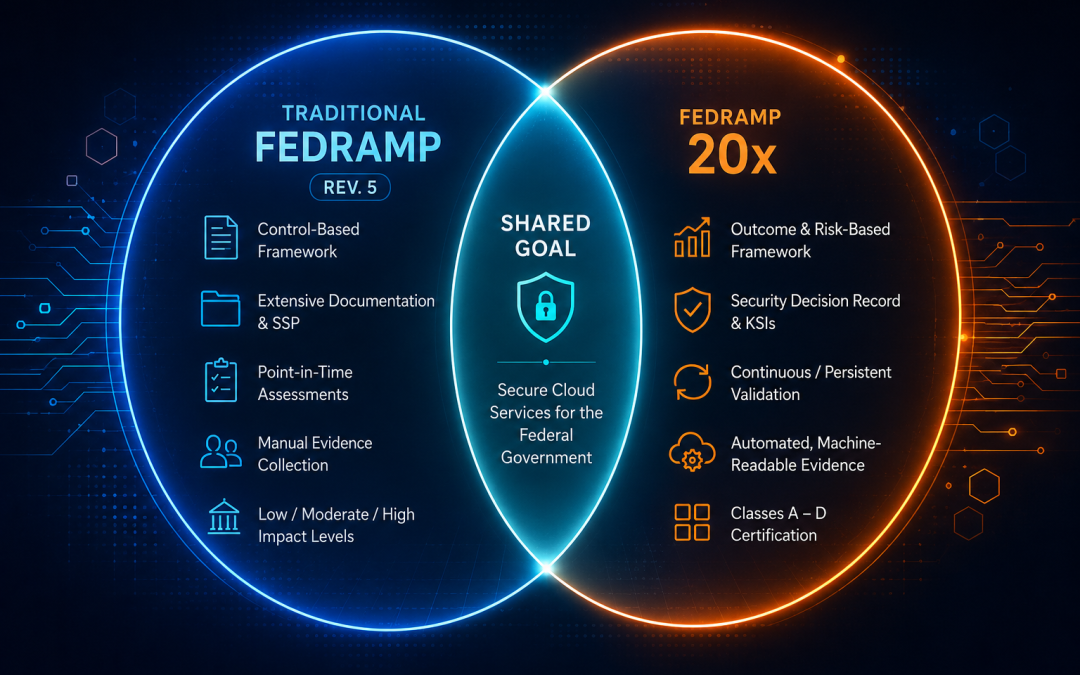
FedRAMP 20x changes how cloud providers demonstrate federal cloud security. Instead of relying mainly on large narrative packages and periodic evidence collection, 20x emphasizes Key Security Indicators, maintained security decisions, structured evidence, automation, and persistent validation.
Executive Summary
FedRAMP 20x Is a Different Way to Prove Cloud Security
Traditional FedRAMP Rev. 5 proves security largely through a formal control-based certification package, independent assessment, federal review, and ongoing monitoring.
FedRAMP 20x proves security through a maintained record of security decisions, Key Security Indicators, measurable outcomes, structured evidence, independent validation, and persistent knowledge of the cloud service’s operating state.
The difference is not that traditional FedRAMP requires security and FedRAMP 20x does not. Both expect cloud providers to protect federal information and maintain a defensible security program.
The biggest change is how the provider explains, measures, validates, and maintains that security.
Rev. 5 asks providers to build and maintain a formal control-based certification package. FedRAMP 20x asks providers to maintain a continuously understandable and verifiable record of security outcomes.
Control and Package Driven
Rev. 5 is based on NIST SP 800-53 controls, a formal SSP, defined assessment procedures, a Security Assessment Report, POA&M management, federal review, and continuous monitoring.
- Detailed control implementation narratives
- Large formal authorization package
- Rev. 5 security baselines
- Independent 3PAO assessment
- Monthly and annual monitoring activities
Outcome and Validation Driven
FedRAMP 20x uses declarative rules, Security Decision Records, KSIs, structured metrics, machine-readable evidence, independent validation, and persistent monitoring.
- Key Security Indicators
- Security Decision Record
- Machine-readable evidence
- Persistent verification and validation
- Certification Classes A through D
What Is Traditional FedRAMP Rev. 5?
Traditional FedRAMP is the long-standing federal process used to assess and certify cloud service offerings for federal use.
It relies on the NIST SP 800-53 Revision 5 control catalog and FedRAMP baselines. The cloud service provider defines its authorization boundary, documents how each applicable control is implemented, prepares policies and procedures, develops architecture and data-flow diagrams, and organizes supporting evidence.
A FedRAMP-recognized Third Party Assessment Organization evaluates the cloud service and produces an assessment report. The certification package is then reviewed through the applicable federal path.
Once certified, the provider must maintain continuous monitoring, submit recurring security information, remediate vulnerabilities, manage significant changes, and support annual assessment activities.
Rev. 5 created a consistent and reusable federal cloud-security model. It reduced the need for every federal agency to build a completely separate assessment of the same cloud product.
Its main challenge is that the package can require extensive manual documentation, evidence organization, assessment coordination, federal review, and continuing maintenance.
What Is FedRAMP 20x?
FedRAMP 20x is a major rearchitecture of the federal cloud-certification program. It is designed to make certification faster, more scalable, easier to reuse, and better aligned with modern cloud operations.
Instead of centering the entire program on lengthy narrative control descriptions, 20x uses simpler declarative rules describing what cloud providers must do.
Providers maintain a Security Decision Record explaining how the service follows the applicable rules. They also maintain Key Security Indicators summarizing important security capabilities and metrics.
The model places strong emphasis on persistent verification and validation. Security information should remain current and understandable rather than being assembled only for a major point-in-time assessment.
FedRAMP 20x does not remove independent assessment. Class B and Class C providers, for example, must include all applicable KSIs in an independent FedRAMP assessment at least annually.
Why FedRAMP Needed to Change
Traditional FedRAMP improved federal cloud security, but the program also became difficult for many smaller SaaS providers and cloud-native companies to enter.
Large documents, manual evidence collection, long review cycles, repeated spreadsheets, difficult package maintenance, and inconsistent interpretation could add time and cost without always improving the government’s understanding of real security outcomes.
Modern cloud services operate through automated deployments, infrastructure as code, containerized workloads, identity federation, continuous integration pipelines, security telemetry, APIs, vulnerability scanners, configuration tools, and real-time monitoring.
A static package can become outdated soon after it is completed. FedRAMP 20x is intended to make the certification record more closely reflect the current operating service.
FedRAMP 20x vs Traditional FedRAMP
Primary Certification Model
A formal control-based package demonstrating how the cloud service implements the applicable FedRAMP baseline.
A maintained security record demonstrating compliance with declarative rules and measurable security outcomes through KSIs.
Primary Security Record
The System Security Plan and related assessment, monitoring, vulnerability, inventory, policy, procedure, and POA&M documents.
The Security Decision Record, KSI information, metrics, validation records, assessment information, clarifications, and supporting artifacts.
Evidence Style
Often includes documents, spreadsheets, screenshots, diagrams, tickets, reports, interviews, demonstrations, and manually organized artifacts.
Prioritizes structured, machine-readable, reproducible, measurable, and persistently maintained evidence from authoritative systems.
Assessment Approach
A major initial assessment followed by continuous monitoring, annual assessment, vulnerability reporting, and significant-change review.
Independent assessment combined with recurring machine and human validation designed to keep the service’s security state continuously understood.
Security Measurement
Control implementation and assessment procedures are the primary organizational structure for documenting security.
KSIs summarize important security capabilities and connect them to decisions, metrics, evidence, validation, and operational outcomes.
Impact Categories and Classes
Historically organized around Low, Moderate, and High impact baselines, with related tailoring and requirements.
Uses Classes A through D to define increasingly complex package, assessment, assurance, and monitoring requirements.
Provider Experience
Often requires extensive formal documentation and assessment coordination before the package reaches federal review.
Intended to reduce unnecessary manual work but may require stronger automation, metrics, integrations, and security-engineering maturity.
Which FedRAMP Path Fits Your Cloud Service?
Emgage helps cloud providers evaluate current FedRAMP paths, define the service boundary, identify evidence gaps, understand 20x readiness, and build a practical certification roadmap.
Review Your FedRAMP ReadinessHow the FedRAMP Evidence Model Is Changing
The difference between Rev. 5 and FedRAMP 20x is not simply that one uses documents and the other uses software.
Both models need documentation and evidence. The difference is how that information is structured, maintained, validated, and reused.
Security Decision Record
Providers maintain a record explaining how the cloud service follows applicable FedRAMP rules, how important security decisions were made, and which evidence supports those decisions.
Key Security Indicators
KSIs summarize important security capabilities and provide measurable ways to understand whether those capabilities are implemented and maintained.
Historical Metrics
Higher classes may require recent and historical metric summaries, allowing agencies and assessors to understand performance over time rather than viewing only one favorable snapshot.
Machine Verification
Machine-based resources and security conditions may need to be verified on recurring schedules, creating a stronger connection between compliance evidence and the current cloud environment.
Independent Validation
Independent assessment remains a key part of the program. Automation does not allow a provider to validate all its own security claims without external oversight.
Evidence still needs to be accurate, complete, scoped correctly, reproducible, understandable, and connected to the security outcome being evaluated.
Point-in-Time Assessment vs Persistent Validation
Traditional FedRAMP is not a one-time audit. Rev. 5 providers have continuing monitoring, vulnerability, reporting, annual assessment, and significant-change obligations.
However, the initial Rev. 5 process is often experienced as a major assessment event. Teams prepare the package, organize evidence, complete formal testing, respond to findings, and submit the materials for review.
FedRAMP 20x makes persistent validation a central design principle. Providers should maintain an intentional, documented, and continuously understood security state.
This means evidence collection should become part of normal engineering and security operations. Identity records, vulnerability results, configuration checks, deployment information, logging metrics, incident records, and validation outputs should remain ready for review.
! Automation Can Also Scale Incomplete Evidence
An automated check is not reliable when it excludes assets, uses the wrong boundary, depends on inaccurate inventory data, applies weak test logic, or fails to trigger remediation.
FedRAMP Classes A Through D
FedRAMP’s 2026 terminology uses certification classes to define increasingly complex package, assurance, validation, and monitoring requirements.
Previous impact labels may continue to appear in parentheses during the transition to help agencies and providers understand the relationship between the older and newer terminology.
Providers should not assume that every old impact label has a simple permanent one-to-one replacement. The applicable class is determined through the current certification rules and package requirements.
Class A
The initial or entry-level 20x class, with requirements designed for lower-risk services and the developing FedRAMP 20x certification ecosystem.
Class B
Adds stronger package, historical metric, validation, and independent assessment expectations suitable for more significant federal use.
Class C
Requires more extensive evidence, daily historical metric information where available, recurring validation, and greater assurance.
Class D
Represents the highest and most complex class in the current structure, with the strongest applicable assessment and monitoring expectations.
How Assessment Changes Under FedRAMP 20x
FedRAMP 20x is sometimes described as if automation replaces formal assessment. That is not accurate.
Independent verification and validation remain important, particularly for higher certification classes. FedRAMP 20x changes what the assessor examines and how often certain information is validated.
The assessor may evaluate the provider’s Security Decision Record, KSI measurements, evidence sources, automation, data quality, validation methods, historical performance, exception handling, and remediation processes.
The provider must also show that machine-generated information can be trusted. Assessors may need to understand where the data originates, what it covers, how frequently it is generated, and how failures are addressed.
A well-designed automated evidence system may reduce repetitive manual work. A poorly designed system can create new findings because inaccurate or incomplete data is being produced at scale.
What FedRAMP 20x Means for Cloud Providers
FedRAMP 20x may be especially attractive to cloud-native companies that already operate through automation, infrastructure as code, centralized logging, measurable security processes, modern identity tools, and integrated DevSecOps workflows.
Rev. 5 may remain practical for providers already far into a sponsored certification process, maintaining an existing package, or following an eligible transition route.
Rev. 5 May Still Fit Providers That:
- Already have a mature Rev. 5 package
- Are actively working with an agency sponsor
- Are well advanced in formal assessment
- Have stable control-based documentation
- Qualify for an available transition path
20x May Fit Providers That:
- Operate modern cloud-native services
- Can generate structured evidence
- Use infrastructure as code
- Maintain reliable security telemetry
- Can measure and validate KSIs
Providers should evaluate current rules rather than selecting a path based only on general descriptions. Certification class, agency demand, architecture, market timing, assessment readiness, internal maturity, and transition eligibility all matter.
Is Traditional FedRAMP Going Away?
Traditional FedRAMP Rev. 5 is not disappearing immediately. Existing providers still need to maintain their certifications, and selected Rev. 5 pathways remain available during the transition.
However, FedRAMP has clearly identified 20x as the new direction for the program. The Consolidated Rules for 2026 introduce transition dates, updated Rev. 5 expectations, and a defined end to unrestricted new Rev. 5 certification submissions.
Providers already pursuing Rev. 5 should not abandon substantial work without evaluating their actual status, sponsor relationship, assessment progress, transition eligibility, and certification deadlines.
Providers beginning now should evaluate FedRAMP 20x first and confirm whether a Rev. 5 route remains appropriate and available for their circumstances.
Even Rev. 5 providers can improve readiness by structuring evidence, improving automation, measuring security outcomes, and reducing dependence on manually maintained artifacts.
Will FedRAMP 20x Reduce Certification Costs?
FedRAMP 20x is intended to reduce unnecessary manual work, repeated documentation, review friction, and barriers to entry for cloud providers.
Providers with mature automation may spend less time manually building evidence packages. They may also be able to reuse operational security data more efficiently during assessment and ongoing certification maintenance.
However, the cost does not disappear. Spending may shift toward cloud engineering, evidence integrations, security telemetry, data quality, automation, metrics, validation logic, assessment, and ongoing monitoring.
A provider with weak security maturity should not assume that selecting FedRAMP 20x automatically creates a low-cost certification project.
How to Prepare for FedRAMP 20x
Choose
Confirm the Current Certification Path
Review the Consolidated Rules, certification classes, Marketplace requirements, transition timelines, agency demand, and any Rev. 5 eligibility before committing to a path.
Scope
Define the Cloud Service Boundary
Identify applications, infrastructure, data flows, administrative systems, identities, pipelines, providers, integrations, regions, and shared responsibilities.
Map
Map Security Decisions and KSIs
Connect each applicable requirement and KSI to the provider’s security decisions, implementation, owner, metrics, evidence source, validation method, and remediation process.
Measure
Build Reliable Security Metrics
Define what success looks like, where the data comes from, how frequently it is generated, which assets it covers, and how failed results are escalated.
Automate
Automate High-Volume Evidence
Prioritize inventories, access reviews, vulnerability data, cloud configuration, deployment records, logging, changes, incidents, and recurring validation.
Validate
Test Evidence Before Formal Assessment
Verify complete boundary coverage, reproduce outputs, investigate failures, review historical performance, and ensure assessors can understand the results.
Sustain
Operate Continuously
Maintain evidence, metrics, vulnerabilities, decisions, exceptions, incidents, changes, assessments, and significant-change records as normal operations.
Frequently Asked Questions
What is the biggest difference between FedRAMP 20x and traditional FedRAMP?
Rev. 5 centers on a detailed control-based certification package. FedRAMP 20x centers on declarative rules, maintained security decisions, KSIs, structured evidence, and persistent validation.
Is FedRAMP 20x officially available?
Yes. FedRAMP released its Consolidated Rules for 2026 and announced the opening schedule for Class A, Class B, and Class C certification pipelines during 2026.
Is traditional FedRAMP Rev. 5 still available?
Rev. 5 remains part of the transition for existing certifications and selected eligible pathways, but providers should review the current submission deadlines and transition rules.
Does FedRAMP 20x eliminate the SSP?
FedRAMP 20x replaces much of the traditional narrative package with a Security Decision Record, KSI information, metrics, validation records, and supporting artifacts. Security documentation is still required.
Does FedRAMP 20x eliminate independent assessments?
No. Independent verification and validation remain required under applicable certification-class rules, including recurring assessment of KSIs for higher classes.
Are Low, Moderate, and High going away?
FedRAMP has transitioned to Classes A through D for certification package specifications. Previous impact labels may still appear during the terminology transition, and risk and assurance differences still matter.
Is FedRAMP 20x cheaper?
It is designed to reduce unnecessary manual burden and review friction. Actual savings depend on the provider’s existing security maturity, automation, service boundary, evidence quality, assessment scope, and remediation needs.
Should a provider already pursuing Rev. 5 switch to 20x?
Not automatically. The provider should review its sponsor relationship, progress, assessment status, sunk cost, eligibility, deadlines, federal demand, and readiness for 20x evidence requirements.
The Bottom Line
Traditional FedRAMP Rev. 5 created a trusted and reusable federal cloud-security process. Its primary structure is a formal control-based certification package supported by independent assessment and ongoing monitoring.
FedRAMP 20x keeps the goal of secure federal cloud adoption but changes how cloud providers demonstrate security.
The newer model emphasizes declarative rules, maintained Security Decision Records, Key Security Indicators, structured evidence, historical metrics, independent validation, and persistent awareness of the service’s security state.
Rev. 5 is not disappearing immediately, but providers should no longer treat FedRAMP 20x as a distant pilot concept. The 2026 rules and certification pipelines make it an active path that cloud providers should evaluate now.
The providers most prepared for 20x will be those that can generate trustworthy evidence from normal operations rather than rebuilding their compliance story before every assessment.
Official Sources
- FedRAMP 20x Overview
- FedRAMP Consolidated Rules for 2026 Announcement
- FedRAMP 20x Certification Rules
- FedRAMP Security Decision Record Requirements
- Independent Verification and Validation
- Persistent Validation and Assessment Standard
- FedRAMP Rev. 5 Agency Authorization
- FedRAMP Rev. 5 Transition Updates
Prepare for FedRAMP 20x Without Losing the Work You Already Have
Emgage helps cloud providers evaluate certification paths, define scope, map KSIs, organize evidence, build security records, identify automation opportunities, and create a practical FedRAMP readiness roadmap.
Review Your FedRAMP Strategy