
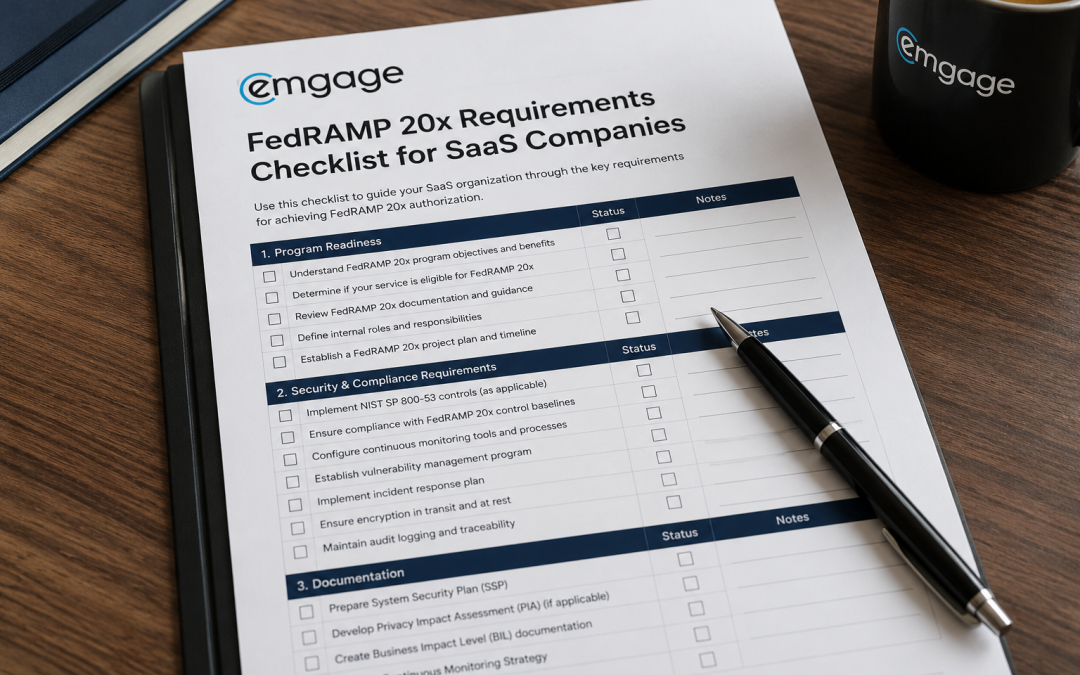
FedRAMP 20x Requirements Checklist for SaaS Companies
FedRAMP 20x is changing how SaaS companies prepare for federal cloud certification by emphasizing measurable security outcomes, machine-readable evidence, automated validation, Key Security Indicators, and continuously maintained security information.
Executive Summary
For SaaS companies, the practical question is no longer simply, “Do we have policies?” The more important question is whether the company can consistently prove that its cloud security capabilities are implemented and operating.
This checklist breaks down the major FedRAMP 20x readiness areas SaaS providers should evaluate before beginning the certification process. It is not a substitute for current official FedRAMP rules, certification-class requirements, or assessor guidance, but it provides a practical starting point for identifying readiness gaps.
What FedRAMP 20x Requires
FedRAMP 20x is designed to move federal cloud certification away from an overly paperwork-heavy review model and toward measurable security outcomes supported by current evidence.
For SaaS providers, the most significant practical changes involve how security is demonstrated. Providers should be prepared to show that important security capabilities operate in practice, not merely that they are described in policies or lengthy control narratives.
The FedRAMP 20x model also uses certification classes and structured rulesets intended to make certification requirements more modular and easier to address. Depending on the current path, providers may need to work through Marketplace listing, service-boundary, assurance, evidence, assessment, and ongoing certification requirements.
FedRAMP 20x readiness means being able to prove that the SaaS environment is secure, measurable, well defined, independently understandable, and continuously supported by reliable evidence.
Define Your FedRAMP Boundary
The FedRAMP boundary defines the cloud service offering being certified and the systems, services, data flows, integrations, users, infrastructure, and operational components that support it.
This can be complicated for SaaS companies because the product may rely on infrastructure providers, databases, APIs, CI/CD pipelines, identity providers, support systems, monitoring platforms, external integrations, and administrative tools.
Service Boundary Checklist
- Can you clearly define the SaaS product or cloud service offering being certified?
- Do you know where federal customer data would be stored, processed, transmitted, backed up, and deleted?
- Have you mapped applications, databases, networks, APIs, administrative systems, and supporting services?
- Are third-party integrations, external dependencies, and inherited services documented?
- Are inherited security capabilities from infrastructure providers clearly identified?
- Do architecture and data-flow diagrams accurately match the current production environment?
- Can leadership, engineering, security, and assessors consistently explain what is inside and outside the boundary?
An unnecessarily broad or poorly defined boundary can increase cost, expand the required evidence set, create confusion during assessment, and introduce systems that are not prepared for federal certification.
A carefully designed boundary can reduce unnecessary work while making responsibilities, dependencies, and security decisions easier to defend.
Understand Key Security Indicators
Key Security Indicators, commonly called KSIs, are one of the most important FedRAMP 20x concepts. They summarize meaningful cloud-security capabilities and connect those capabilities to evidence and validation.
Instead of treating every security requirement as an isolated documentation task, the KSI model helps providers explain the intended security outcome, the decision used to achieve it, the evidence supporting that decision, and the method used to validate it.
KSI Readiness Checklist
- Does your team understand the KSIs associated with the intended certification path?
- Can each KSI be mapped to a documented security decision?
- Can each security decision be connected to authoritative operational evidence?
- Can the team define pass, fail, threshold, and exception conditions for validation?
- Can evidence be regenerated when the service or assessment package changes?
- Can engineering and security personnel explain what each evidence source proves?
- Can assessor questions and findings be connected back to the relevant KSI and evidence?
Need Help Understanding FedRAMP 20x KSIs?
Emgage can help your SaaS company identify which security decisions, evidence sources, documentation, and validation gaps may affect FedRAMP 20x readiness.
Start a Readiness AssessmentPrepare Machine-Readable Evidence
FedRAMP 20x places strong emphasis on structured and machine-readable certification information that can be evaluated, validated, updated, and regenerated more efficiently.
For SaaS companies, this means evidence should not live exclusively in screenshots, PDFs, emails, or disconnected spreadsheets. Those formats may still provide context, but authoritative evidence should increasingly come from the systems operating the service.
Machine-Readable Evidence Checklist
- Can your systems produce structured evidence through reports, exports, APIs, schemas, or validation outputs?
- Can identity, vulnerability, logging, configuration, asset, and deployment evidence be produced consistently?
- Can evidence be regenerated on demand without rebuilding the entire package manually?
- Are evidence formats, field names, relationships, and source systems consistent?
- Is each artifact labeled clearly enough for an independent reviewer to understand its purpose?
- Can the team explain validation failures, missing information, exclusions, and exceptions?
- Can evidence be traced to the relevant KSI, security decision, source, owner, date, and service component?
Strong evidence should be repeatable, current, scoped correctly, understandable to an assessor, and traceable to an authoritative system.
A large collection of screenshots does not necessarily create strong evidence if the screenshots are stale, incomplete, difficult to reproduce, or disconnected from the security outcome being evaluated.
Prove Identity and Access Controls
Identity and access management is one of the most important security areas for SaaS providers. Federal customers need assurance that users, administrators, developers, service accounts, and support personnel are properly authenticated, authorized, reviewed, and removed.
- Is MFA enforced for privileged, administrative, and other applicable access?
- Can you produce a current inventory of users, administrators, service accounts, and machine identities?
- Can you prove who currently has access to production environments?
- Are privileged accounts and permissions reviewed regularly?
- Is least privilege enforced through roles, groups, policies, and approval processes?
- Are onboarding, transfers, and offboarding workflows documented and tested?
- Can access changes be traced to an authorized request and approval?
- Can identity evidence be exported and regenerated for independent review?
Validate Vulnerability Management
FedRAMP 20x readiness depends on knowing whether vulnerabilities are consistently identified, evaluated, prioritized, remediated, documented, and tracked over time.
Vulnerability Management Checklist
- Are vulnerability scans performed across all applicable in-scope assets and environments?
- Can you prove current scan coverage and identify excluded or unsupported assets?
- Can you show severity, exploitability, affected assets, ownership, and remediation status?
- Are remediation deadlines and service-level expectations defined and tracked?
- Can closed vulnerabilities be proven resolved through rescanning or validation?
- Are risk acceptances and exceptions documented, approved, time limited, and reviewed?
- Can vulnerability evidence be regenerated in a consistent and understandable format?
- Are container, dependency, code, infrastructure, application, and cloud vulnerabilities addressed where applicable?
Centralize Logging and Monitoring
SaaS companies preparing for FedRAMP 20x need reliable visibility into security events across the service boundary. Logs should support investigation, alerting, incident response, validation, and historical review.
Logging and Monitoring Checklist
- Are logs centralized for all applicable in-scope systems, applications, identities, and cloud services?
- Are security-relevant events defined and collected consistently?
- Are alerts assigned, reviewed, investigated, documented, and closed?
- Is access to logs restricted and monitored?
- Are logs protected against unauthorized modification or deletion?
- Are logs retained for the required period and available when needed?
- Can you prove recurring log-review and monitoring activity?
- Can monitoring data support KSI validation, incident response, and assessor review?
Secure Cloud Configuration
SaaS providers should know how the service, infrastructure, applications, identities, and customer-facing settings are securely configured and how configuration drift is detected.
Cloud Configuration Checklist
- Do you maintain documented secure configuration baselines?
- Can you detect unauthorized changes and configuration drift?
- Are privileged and top-level cloud accounts documented and tightly controlled?
- Are security-relevant product settings clearly explained?
- Can configuration evidence be exported from authoritative systems?
- Are changes reviewed, approved, tested, and traceable?
- Are infrastructure-as-code and deployment templates reviewed and protected?
- Can federal customers understand how to configure and operate the service securely?
! Customer Configuration Matters
When a SaaS product allows customers to enable or disable security features, the provider should clearly explain the security effect of those settings and identify customer responsibilities.
Maintain Documentation and SSP Readiness
FedRAMP 20x reduces dependence on lengthy static narratives, but it does not eliminate documentation. Providers still need accurate records explaining service boundaries, security decisions, evidence, responsibilities, risks, dependencies, procedures, and changes.
Documentation Checklist
- Do you have a current SSP foundation or equivalent service-security documentation?
- Are architecture, network, trust-boundary, and data-flow diagrams accurate?
- Are security policies and operating procedures current and approved?
- Are findings, remediation work, risks, and POA&M items tracked consistently?
- Are risk decisions documented with owners, approvals, expiration dates, and review requirements?
- Does the documentation match the service’s actual operation and configuration?
- Can documents and security records be updated efficiently as the product changes?
- Are shared responsibilities and inherited capabilities clearly described?
Assign Ownership and Governance
FedRAMP 20x is not simply a compliance-team exercise. Readiness requires coordinated ownership across leadership, engineering, security, operations, compliance, product, and customer-support teams.
Engineering Ownership
Supports architecture, infrastructure, CI/CD, secure development, change management, technical evidence, cloud configuration, and remediation.
Security Ownership
Manages identity, monitoring, vulnerabilities, incident response, risk evaluation, security tooling, evidence quality, and ongoing validation.
Compliance Ownership
Maps requirements, maintains certification records, coordinates evidence, tracks findings, manages documentation, and prepares for assessment.
Leadership Ownership
Approves resources, understands costs and timelines, resolves priorities, accepts risk, and aligns FedRAMP investment with federal growth strategy.
Common SaaS Mistakes With FedRAMP 20x Requirements
FedRAMP 20x may reduce unnecessary friction, but weak planning can still create delays, duplicated work, excessive scope, and unnecessary technology spending.
FedRAMP 20x Readiness Starts With Evidence
FedRAMP 20x is pushing SaaS companies toward a more modern certification model. The future of FedRAMP is not simply about writing shorter documents. It is about proving security outcomes through current, structured, repeatable, and independently understandable evidence.
SaaS companies that prepare early will be in a stronger position. They will understand their system boundary, know where authoritative evidence exists, identify missing security capabilities, align internal teams, and build a clearer path toward certification.
The best place to start is a readiness assessment. Before spending heavily on software, consultants, assessors, or implementation work, determine where the SaaS offering stands today and which gaps will create the greatest cost or delay.
Ready to Check Your FedRAMP 20x Requirements?
Emgage can help your SaaS company identify service-boundary issues, evidence gaps, documentation needs, security-control weaknesses, automation opportunities, and the fastest practical path toward FedRAMP readiness.
Start Your FedRAMP Readiness Review