
Do FedRAMP 20x and CMMC Level 2 Overlap?
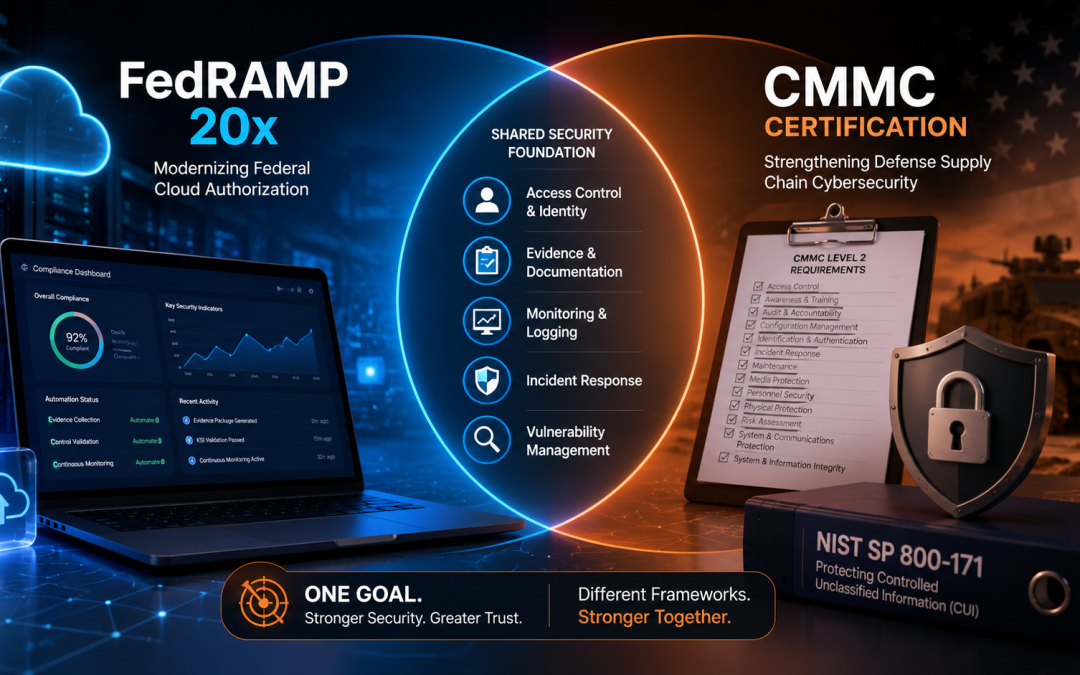
FedRAMP 20x and CMMC Level 2 share important cybersecurity concepts, operational practices, and evidence sources. However, they evaluate different environments and produce different compliance outcomes. The opportunity is evidence reuse—not automatic equivalence.
Executive Summary
Yes, FedRAMP 20x and CMMC Level 2 Overlap—but They Are Not Equivalent
Both programs expect organizations to implement security, document responsibilities, preserve evidence, manage vulnerabilities, respond to incidents, and maintain their security posture.
That creates meaningful opportunities to reuse security tools, policies, procedures, monitoring, technical evidence, and governance processes.
The overlap does not mean a FedRAMP Certification automatically satisfies CMMC Level 2. FedRAMP evaluates the security of a cloud service offering. CMMC evaluates whether the defense contractor protects CUI across its applicable environment.
The contractor must still prove that its users, devices, tenant settings, internal systems, facilities, processes, documentation, data flows, and external-service relationships satisfy the applicable CMMC requirements.
FedRAMP evidence may support CMMC readiness, but every artifact must be mapped and validated against the contractor’s actual CUI scope and the specific CMMC assessment objective.
Cloud Service Certification
Evaluates security information for a defined cloud service offering intended for federal use.
- Cloud service boundary
- Security Decision Record
- Key Security Indicators
- Machine-readable evidence
- Persistent validation
- Independent assessment where required
Contractor CUI Protection
Evaluates whether a defense contractor protects CUI across the applicable contractor environment.
- CUI assessment scope
- NIST SP 800-171 requirements
- System Security Plan
- Assessment evidence
- POA&M where permitted
- Annual affirmation and reassessment
What FedRAMP 20x Covers
FedRAMP 20x is a modern federal cloud-certification model built around measurable security outcomes, maintained security decisions, structured evidence, persistent validation, and certification classes.
The provider documents how the cloud service follows applicable FedRAMP rules within a maintained Security Decision Record.
Key Security Indicators summarize important security outcomes and connect those outcomes to implementation, measurements, evidence sources, validation, assessment, historical results, failures, and remediation.
FedRAMP 20x focuses on the defined cloud service offering. That may include applications, infrastructure, regions, identities, administrative systems, support operations, software pipelines, dependencies, logging, monitoring, incident response, and secure configuration guidance.
What CMMC Level 2 Covers
CMMC Level 2 focuses on protecting Controlled Unclassified Information within the Defense Industrial Base.
The current Level 2 assessment model evaluates the 110 security requirements in NIST SP 800-171 Revision 2.
Depending on the contract requirement, the organization may need a Level 2 self-assessment or a certification assessment performed by a C3PAO.
The contractor must define its CUI scope, maintain an accurate SSP, preserve objective evidence, address allowed POA&M items, affirm continuing compliance, and maintain the assessed environment over time.
CMMC may include endpoints, users, cloud tenants, local networks, facilities, printers, removable media, mobile devices, security tools, external service providers, physical files, and other assets involved in protecting CUI.
Why Scope Determines Whether Evidence Can Be Reused
The same technical control can exist in both frameworks while protecting different systems, users, information, and responsibilities.
An identity report from the cloud provider may show that privileged access inside the service boundary is well controlled. That does not automatically prove that the contractor properly manages its own tenant administrators, employees, service accounts, local devices, or application permissions.
Evidence reuse therefore begins with scope—not with a spreadsheet claiming two requirements are similar.
FedRAMP Cloud-Service Boundary
The systems and operations used to deliver and secure the certified cloud offering.
CMMC Contractor Environment
The contractor assets and processes that handle CUI or provide security protection for it.
Where FedRAMP 20x and CMMC Level 2 Overlap
The frameworks share many foundational cybersecurity capabilities even though their exact requirements, evidence, and assessed boundaries differ.
Identity and Access Management
MFA, account lifecycle management, least privilege, privileged access, role definitions, service accounts, access reviews, and authentication records may support both programs.
Vulnerability and Flaw Remediation
Asset coverage, scanning, severity, remediation tickets, exceptions, rescanning, timelines, metrics, and closure evidence may be reused after confirming scope.
Incident Response
Incident plans, roles, exercises, escalation, analysis, containment, recovery, reporting, after-action reviews, and corrective actions support related requirements.
Configuration and Change Management
Secure baselines, change approvals, testing, deployment records, infrastructure as code, configuration monitoring, and drift detection can support both programs.
Security Documentation
Architecture, data flows, policies, procedures, responsibilities, security decisions, system descriptions, and operational records can often be reused or adapted.
Governance and Continuous Operations
Control ownership, risk tracking, management oversight, recurring reviews, training, evidence maintenance, and remediation governance can support both frameworks.
How Much FedRAMP Evidence Can Be Reused for CMMC?
Evidence reuse usually falls into three categories.
High Reuse Potential
High overlapOrganization-wide policies, incident-response processes, vulnerability workflows, security-training records, governance procedures, and common security tools may support both programs with limited adjustment.
Partial Reuse Potential
Validate scopeIdentity reports, logging records, scanner results, configuration evidence, architecture diagrams, and technical procedures may support both only when they cover the relevant contractor systems and CUI responsibilities.
Low or No Direct Reuse
Framework specificCUI scoping, contractor SSP details, physical protection, local endpoints, SPRS information, contract flow-downs, CMMC affirmations, and contractor-specific assessment records usually require separate work.
A successful crosswalk confirms that the evidence proves the required security outcome within the correct CMMC scope.
Where FedRAMP 20x and CMMC Requirements Differ
The differences are substantial enough that organizations should manage the programs as coordinated but separate compliance efforts.
Different Boundaries
FedRAMP evaluates the cloud service offering. CMMC evaluates the contractor environment protecting FCI or CUI.
Different Security Models
CMMC Level 2 evaluates NIST SP 800-171 requirements. FedRAMP 20x uses its current program rules, KSIs, security decisions, evidence, and class-based assurance requirements.
Different Authorities
FedRAMP supports federal cloud certification and agency risk decisions. CMMC supports defense-contract eligibility and protection of covered information.
Different Outcomes
FedRAMP Certification applies to a cloud offering. CMMC Status applies to the assessed contractor environment and relevant contract requirements.
Different Documentation
FedRAMP 20x centers on maintained security decisions and KSI information. CMMC Level 2 requires an accurate contractor SSP and assessment evidence.
Different Maintenance Obligations
FedRAMP providers maintain certification information and validation. CMMC contractors maintain assessment scope, annual affirmation, evidence, SSP accuracy, and reassessment obligations.
See Which FedRAMP Evidence Can Support Your CMMC Program
Emgage helps organizations map shared requirements, validate evidence scope, identify CMMC-specific gaps, centralize documentation, and reduce duplicated compliance work.
Review Your Framework OverlapHow a FedRAMP Cloud Provider Can Support CMMC
A contractor may use a FedRAMP-certified cloud service as part of its CUI environment.
The provider’s certification package can give the contractor valuable information about the service boundary, security implementation, assessment, monitoring, vulnerabilities, incidents, configuration responsibilities, and inherited capabilities.
This can reduce the amount of security work the contractor must independently perform inside the provider’s infrastructure.
The contractor still needs to determine whether the exact service offering, region, features, contract terms, incident obligations, evidence, and configuration are appropriate for its DFARS and CMMC requirements.
! Verify the Exact Cloud Offering
Commercial, federal, government, and defense versions of the same SaaS product may have different boundaries, features, locations, security settings, and compliance status.
What the CMMC Contractor Still Owns
Cloud-provider security does not replace contractor security.
How FedRAMP and CMMC Overlap Can Reduce Costs
Companies increase compliance costs when they manage the frameworks in separate silos.
Different teams may purchase overlapping tools, write duplicate policies, collect the same evidence twice, maintain conflicting inventories, and track identical vulnerabilities in separate systems.
A coordinated program can establish common evidence sources and governance while preserving framework-specific scopes and requirements.
Potential Shared Investments
- Identity and access platforms
- Security logging and SIEM
- Vulnerability-management systems
- Incident-response processes
- Configuration-management tools
- Evidence repositories
- Security policies and training
- Risk and remediation governance
CMMC-Specific Work That Remains
- CUI scoping and data flows
- Contractor SSP development
- Local endpoint and network controls
- Physical protection requirements
- NIST SP 800-171 gap remediation
- SPRS and assessment preparation
- Annual affirmation
- Contract-specific obligations
The savings come from using common tools, evidence, governance, and operating processes where they genuinely support both programs.
When Might a Company Need Both FedRAMP and CMMC?
A cloud provider may pursue FedRAMP Certification for its SaaS product while separately needing CMMC for a corporate or contractor environment that receives DoD CUI.
A managed service provider may support federal cloud systems while also serving defense contractors subject to CMMC requirements.
A defense contractor may develop a hosted platform for federal customers while also processing CUI within internal engineering, manufacturing, or program-management systems.
In these situations, the organization should define separate but coordinated boundaries.
The same security team and tools may support both, but the FedRAMP cloud offering and the CMMC contractor environment should not be assumed to be identical.
How to Build a Defensible FedRAMP-to-CMMC Crosswalk
Define Both Boundaries
Document the FedRAMP cloud service boundary and the CMMC contractor scope separately before mapping controls or evidence.
Map Security Outcomes
Compare what each requirement is trying to achieve rather than relying only on similar wording or automated framework mappings.
Assign Responsibility
Identify whether the provider, contractor, shared platform, or another external service performs each part of the implementation.
Validate Evidence Coverage
Confirm that the artifact includes the correct assets, users, dates, configurations, responsibilities, and assessment objective.
Document Remaining Gaps
Record which CMMC objectives are fully supported, partially supported, unsupported, or require additional contractor evidence.
Maintain the Crosswalk
Update mappings when systems, provider responsibilities, FedRAMP rules, CMMC requirements, architecture, or evidence sources change.
Common FedRAMP and CMMC Overlap Mistakes
FedRAMP 20x and CMMC Overlap Readiness Checklist
Frequently Asked Questions
Do FedRAMP 20x and CMMC Level 2 overlap?
Yes. They share security concepts involving identity, logging, vulnerabilities, incidents, configuration, evidence, documentation, and continuous security operations.
Does FedRAMP 20x automatically satisfy CMMC Level 2?
No. The contractor must still satisfy CMMC requirements across its applicable CUI environment and demonstrate the required assessment objectives.
Does CMMC Level 2 automatically satisfy FedRAMP?
No. CMMC does not create the cloud-service certification package, security decisions, KSI information, validation, or assessment required by FedRAMP.
Can FedRAMP evidence be reused during a CMMC assessment?
It may be reused when it supports the correct requirement, system scope, implementation, responsible party, date, and assessment objective.
Does using a FedRAMP cloud service make a contractor CMMC compliant?
No. It may satisfy part of the external-cloud requirement, but the contractor remains responsible for its tenant, users, devices, systems, policies, SSP, data flows, and evidence.
What evidence has the highest reuse potential?
Governance policies, incident-response processes, vulnerability workflows, access records, logging evidence, training, and centralized security-tool outputs often have strong reuse potential.
What CMMC work usually remains separate?
CUI scoping, contractor SSP content, endpoints, facilities, physical media, tenant configuration, SPRS information, annual affirmation, and contractor-specific assessment evidence.
Can framework overlap reduce CMMC costs?
Yes. Coordinated governance, shared tools, centralized evidence, common policies, and deliberate cross-mapping can reduce duplicated work.
Should an organization maintain one SSP for both frameworks?
Not automatically. FedRAMP 20x and CMMC document different scopes and requirements. Shared source information can be reused, but each required certification record should remain accurate for its purpose.
Can a company need both certifications?
Yes. A company may provide a cloud service to federal agencies while separately acting as a DoD contractor that handles CUI.
The Bottom Line
FedRAMP 20x and CMMC Level 2 overlap in meaningful cybersecurity and evidence areas.
Identity, logging, vulnerabilities, incidents, configuration, documentation, monitoring, training, and governance can often support both programs.
The opportunity is to reuse validated evidence and shared security investments while preserving the different scopes, requirements, responsibilities, and assessment outcomes.
A FedRAMP-certified cloud service can strengthen a contractor’s CMMC environment, but it does not make the contractor compliant. CMMC evaluates how the contractor configures and uses that service together with its users, endpoints, networks, facilities, procedures, and other systems.
The strongest strategy is a coordinated compliance program with two clearly defined boundaries, one source of truth for shared evidence, and documented framework-specific gaps.
Reuse Shared Evidence Without Missing CMMC-Specific Gaps
Emgage helps organizations define both scopes, map overlapping requirements, validate shared evidence, organize documentation, identify contractor responsibilities, and reduce unnecessary compliance costs.
Review Your FedRAMP and CMMC Overlap