
CMMC 2.0 Overview: Final Rule, Requirements, and 2025 Deadlines
The Department of Defense (DoD) has officially moved forward with CMMC 2.0, and for government contractors, the impact is significant. With the CMMC Final Rule now published and enforcement approaching, both prime contractors and subcontractors must take concrete steps to meet CMMC 2.0 requirements to continue bidding on high-dollar DoD contracts.
This overview explains what CMMC 2.0 is, what the Final Rule requires, and what contractors should be doing now to prepare for the 2025 CMMC deadlines.
What Is CMMC 2.0?
A CMMC gap assessment is a structured evaluation of your current cybersecurity posture against the CMMC compliance requirements applicable to your organization. It typically includes:
- Reviewing CMMC controls and NIST 800-171 requirements
- Evaluating policies, procedures, and technical safeguards
- Identifying gaps that affect CMMC compliance readiness
- Assessing risks related to CMMC CUI and FCI
- Estimating effort, cost, and CMMC implementation timeline
Unlike a formal CMMC audit, a gap assessment is internal and corrective in nature. Its purpose is to prepare you—not to certify you.
CMMC 2.0 Levels and Requirements
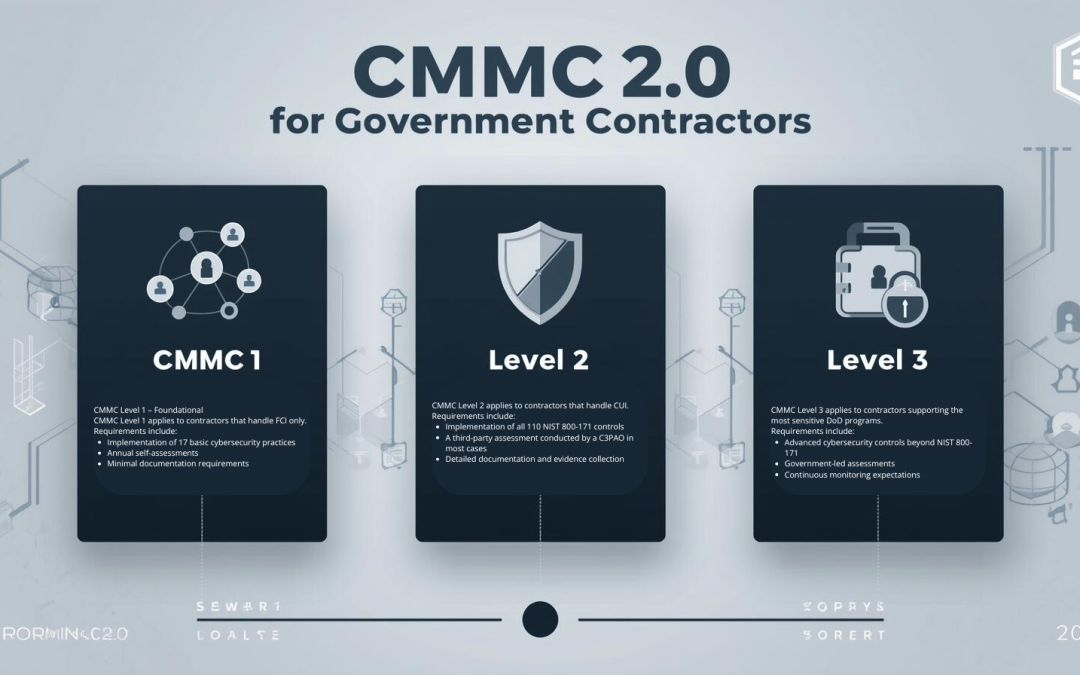
CMMC Level 1 – Foundational
CMMC Level 1 applies to contractors that handle FCI only.
Requirements include:
- Implementation of 17 basic cybersecurity practices
- Annual self-assessments
- Minimal documentation requirements
Level 1 is most common among smaller subcontractors and suppliers.
CMMC Level 2 – Advanced
CMMC Level 2 applies to contractors that handle CUI.
Requirements include:
- Implementation of all 110 NIST 800-171 controls
- A third-party assessment conducted by a C3PAO in most cases
- Detailed documentation and evidence collection
Some limited self-assessments may be allowed in low-risk scenarios, but most organizations should expect a formal audit.
CMMC Level 3 – Expert
CMMC Level 3 applies to contractors supporting the most sensitive DoD programs.
Requirements include:
- Advanced cybersecurity controls beyond NIST 800-171
- Government-led assessments
- Continuous monitoring expectations
The CMMC Final Rule Explained
The CMMC Final Rule, published through the Federal Register, formally establishes CMMC 2.0 as a contractual requirement. Once fully implemented, CMMC requirements will be embedded directly into DoD solicitations and contracts through DFARS clauses.
Key points from the Final Rule include:
- CMMC certification will be required prior to contract award
- Certification levels will be specified in solicitations
- Self-assessment results are subject to False Claims Act liability
- Subcontractors are equally responsible for compliance
CMMC is no longer optional or theoretical—it is a binding contractual obligation.
CMMC November 10 2025 Deadlines and Phased Rollout
CMMC enforcement will follow a phased rollout as the DoD incorporates certification requirements into new contracts.
While implementation varies by program, November 2025 is widely considered the critical year when:
- Most new DoD contracts will include CMMC requirements
- Prime contractors will require subcontractor compliance
- Non-compliant companies risk losing contract eligibility
Organizations that wait until CMMC appears in a solicitation often find themselves behind schedule.
What Contractors Should Do Now
To prepare for CMMC 2.0, contractors should take the following steps:
- Identify which CMMC level applies to their contracts
- .Determine whether they handle FCI or CUI
- Conduct a CMMC self-assessment or gap assessment
- Estimate required cost, timeline, and resources
- Develop a clear compliance and certification strategy
Early readiness significantly reduces both cost and risk.
Preparing for CMMC Without Overcommitting
One of the biggest challenges contractors face is uncertainty around scope, cost, and documentation. Modern CMMC readiness platforms allow organizations to:
- Complete interactive self-assessments
- Automatically generate POAMs and required policies
- Estimate certification cost and timeline
- Cross-map CMMC controls to other cybersecurity frameworks
This approach allows companies to move forward with clarity instead of guesswork.
Final Thoughts
CMMC 2.0 is no longer a future concern—it is an active requirement that will determine who can compete for DoD contracts in 2025 and beyond. Understanding the Final Rule, certification levels, and enforcement timelines is the first step toward protecting both eligibility and revenue.
Contractors that prepare early will have more flexibility, lower costs, and fewer disruptions as CMMC requirements continue to roll out.