

Best Practices for Marking and Sending CUI
If you are part of the defense supply chain, you are likely handling CUI whether you realize it or not. Engineering drawings, technical specs, and contract data often fall into this category.
The challenge is not just protecting that information inside your systems. You also need to properly mark it and send it securely.
This is where many companies struggle with CMMC compliance. They may have strong cybersecurity tools in place, but their CMMC documentation and daily processes do not clearly show how CUI is identified and handled.
This article breaks down simple, real-world best practices for marking and sending CUI so your team can stay compliant and avoid costly mistakes.
What Is CUI and Why Marking Matters
CUI (Controlled Unclassified Information) is sensitive government information that requires protection but is not classified.
Common examples in manufacturing include:
Technical drawings
CAD files and specifications
Defense contract information
Supplier and program data
Marking CUI correctly is critical because it tells everyone in your organization how the information should be handled.
According to 32 CFR §2002.20, CUI must be clearly marked so users know it requires safeguarding. If documents are not labeled properly, employees may treat them like normal files, which increases risk.
From a CMMC documentation standpoint, marking is also one of the easiest things for an assessor to verify.
How to Properly Mark CUI

Marking CUI does not need to be complicated, but it does need to be consistent across your organization.
At a minimum, documents that contain CUI should follow the marking guidance defined under 32 CFR §2002.20, which outlines federal requirements for properly identifying and safeguarding controlled information.
In practice, that means:
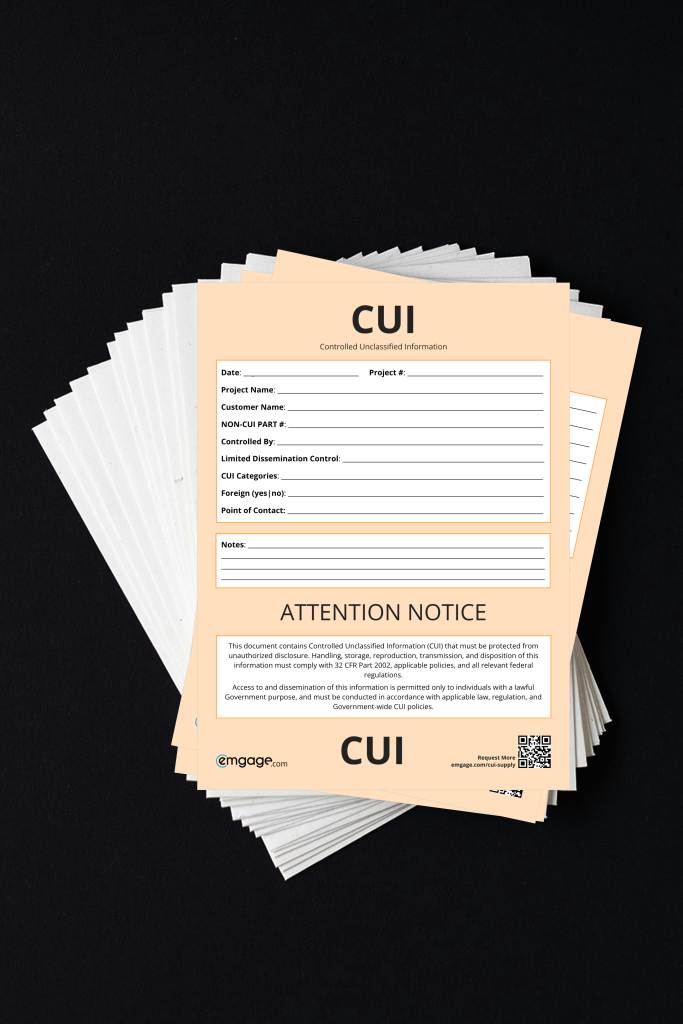
A clear header marking such as “CUI” at the top of the document
A footer marking to reinforce visibility throughout the document
Any required dissemination controls when applicable, such as “NOFORN” or limited distribution statements
These markings are not just best practices. They are part of the federal CUI Program requirements and are expected to be followed by contractors handling sensitive information.
For example, a technical drawing that contains CUI should display the marking on every page. This aligns with 32 CFR §2002.20(a), which requires CUI to be clearly marked so that users understand the need for safeguarding and proper handling.
From a CMMC compliance standpoint, this also ties directly into NIST SP 800-171 Control 3.8.4, which requires organizations to mark media containing CUI to indicate distribution limitations, handling caveats, and safeguarding requirements.
Consistency is where many organizations fall short. If some documents are marked and others are not, employees are left guessing. That creates risk, especially in fast-paced manufacturing environments where information is constantly being shared.
It also becomes a problem during a CMMC assessment. Assessors will look for alignment between your policies, your CMMC documentation, and what is actually happening on the floor. If marking is inconsistent, it signals that CUI is not being fully controlled.
Keeping your marking process simple, repeatable, and aligned with federal requirements is one of the easiest ways to strengthen your overall CMMC compliance posture.
Best Practices for Sending CUI Securely
Sending CUI is where many organizations introduce risk. Email, file sharing, and collaboration tools are often used without clear rules.
To align with CMMC and NIST 800-171 requirements, companies should follow a few core principles.
Always encrypt CUI when sending it outside your organization. This aligns with NIST 800-171 Control 3.13.16, which requires protection of data in transit
Verify the recipient before sending sensitive information. Mistakes in email addresses are a common cause of data exposure
Use secure file transfer solutions when possible instead of sending attachments directly
Avoid sending CUI over personal email accounts or unapproved systems
These practices should be clearly defined in your CMMC documentation so employees know exactly how to handle sensitive data.
Email and CUI: What You Need to Know
Email is one of the most common ways CUI is shared, and also one of the biggest risks.
If your team is sending CUI through email, you need to ensure:
Emails containing CUI are encrypted end-to-end
Attachments are protected with secure access controls
Only authorized users are included in communications
For many companies, this means using a secure email solution such as Microsoft 365 with proper configuration or another encrypted email platform.
Just as important, your policies must clearly explain how employees should send CUI. This is a critical part of strong CMMC documentation and will likely be reviewed during a CMMC assessment.
Common Mistakes That Lead to Non-Compliance
Initializing secure transmission...
Encrypting data...
Sending message...
UNAUTHORIZED SEND
Many companies fail to meet CMMC requirements not because they lack tools, but because their processes are inconsistent.
One common issue is failing to mark documents at all. Another is marking documents inconsistently across departments.
Some organizations rely on employees to “remember” when something is CUI instead of defining it clearly. This leads to mistakes, especially in fast-paced manufacturing environments.
Another major issue is sending CUI without encryption or through unapproved systems. Even a single mistake can create risk and raise red flags during an assessment.
How CMMC Documentation Supports CUI Handling
Strong CMMC documentation connects your policies, procedures, and daily operations.
Your documentation should clearly answer:
-How your organization identifies CUI
-How documents are marked and labeled
-How CUI is stored and transmitted
-What tools are used to protect CUI
-Who is responsible for enforcing these practices
When these processes are documented and followed, it becomes much easier to demonstrate CMMC compliance.
Assessors are not just looking for tools. They are looking for proof that your organization understands how to protect sensitive information at every stage.
Handling CUI correctly is a core part of CMMC compliance, and it goes beyond firewalls and security tools.
Marking documents clearly and sending them securely are two of the most visible and testable parts of your security program.
When your processes are consistent and your CMMC documentation reflects how your team actually works, you reduce risk and make assessments much smoother.
For companies in the defense supply chain, getting this right is not just about compliance. It is about protecting your business and maintaining eligibility for future contracts.
Need A CMMC CUI Kit?
Kickstart your compliance with our free Starter Pack CMMC CUI Kit. Get practical materials, labels, and signs to start handling CUI correctly and move toward CMMC compliance with confidence.